Fixed memory
Keep the optimizer close to the current regime.
Training and validation windows move forward together, dropping older history as each fold advances.
Decision rule
Choose when recent market behavior matters more than distant history.
Overfitting is the #1 reason backtested strategies fail live. Most platforms give you no way to detect it before it costs you real capital. Walk Forward Analysis divides your data into sequential training and validation windows.

Your strategy was built on historical data. Its parameters were chosen because they worked on that specific data.
The uncomfortable question: would those same parameters work on tomorrow's market?
Walk Forward Analysis systematically validates your strategy by training on historical windows and testing on unseen future data—just like deploying to a market you haven't seen yet.
Define your in-sample training window (1–120 months) and out-of-sample validation window (1–60 months). Stratifyre divides your date range into sequential folds—each with a training period followed by a test period. Preview the fold timeline before committing to a run.
For each fold, Stratifyre optimizes your strategy parameters on the in-sample window. Choose Monte Carlo perturbation (10–10,000 iterations) or Grid Search (up to 10,000 combinations). Target any of 6 objective functions: Sharpe, Sortino, CAGR, Return%, Profit Factor, or Calmar.
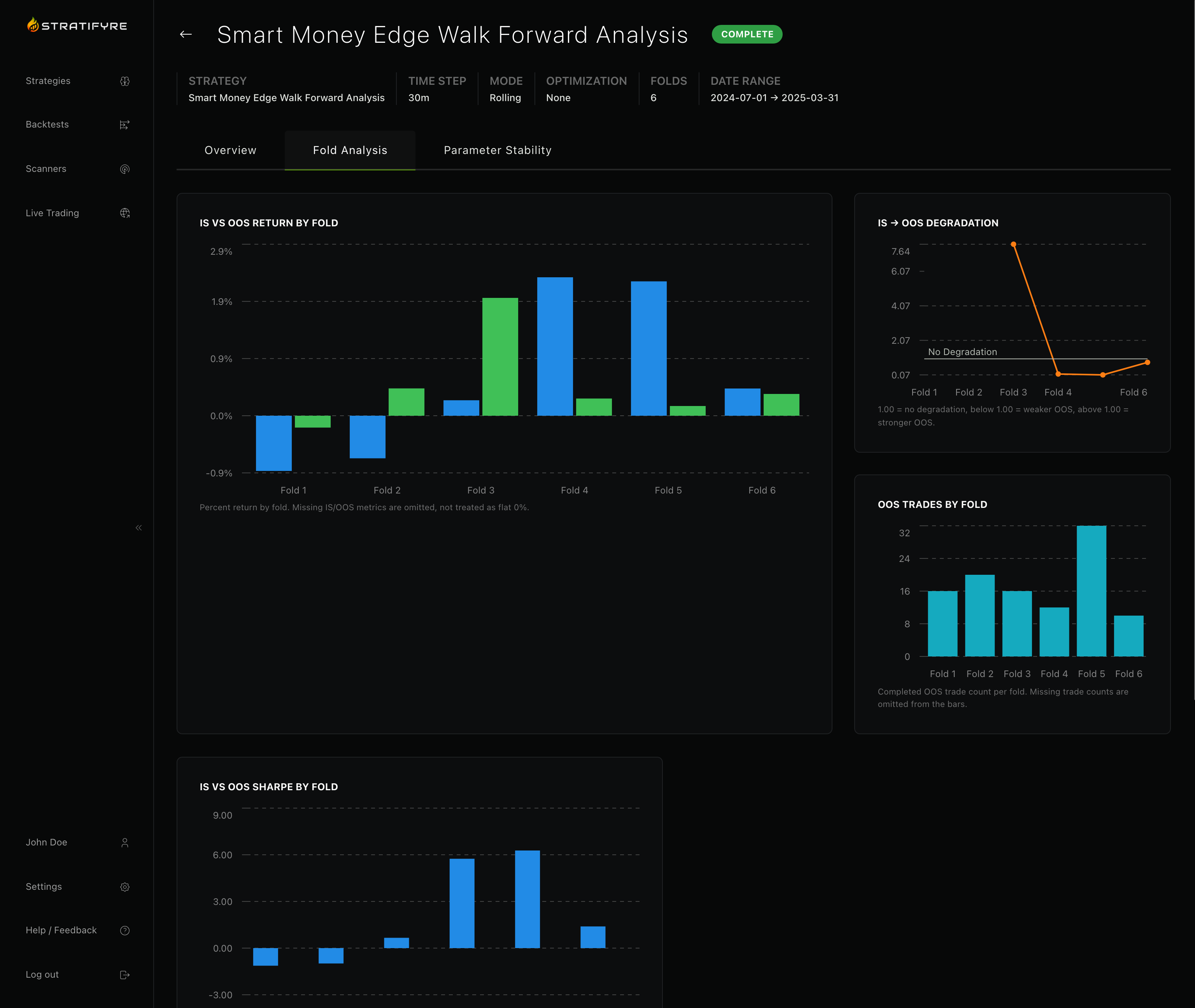
The optimized parameters are applied to the out-of-sample window—data the optimizer never touched. This is the critical test: does the edge survive on unseen data, or does performance collapse? Each fold gives you a degradation ratio.
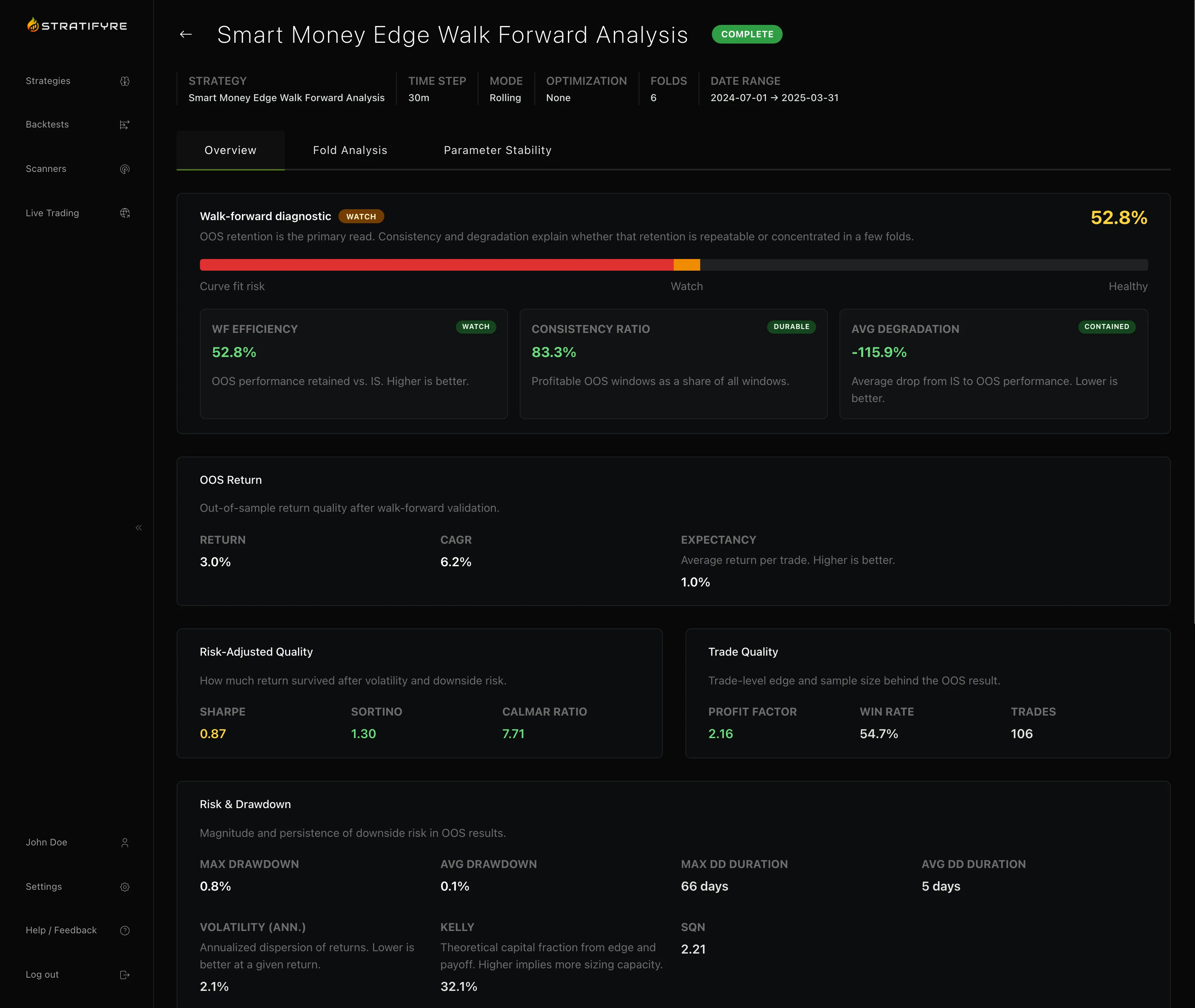
After all folds complete, Stratifyre aggregates the OOS results into a unified equity curve and calculates Walk Forward Efficiency, Consistency Ratio, and Average Degradation. A WFE near 100% means your strategy generalizes well. Below 50%? You're likely curve-fitting.
Pick the validation shape that matches how much history your strategy should remember before it faces unseen data.
Fixed memory
Training and validation windows move forward together, dropping older history as each fold advances.
Decision rule
Choose when recent market behavior matters more than distant history.
Growing evidence
The training window stays anchored at the beginning and expands before each out-of-sample test.
Decision rule
Choose for structural edges that benefit from larger samples.
No optimization
The strategy runs as-is across sequential test windows, with no per-fold parameter search.
Decision rule
Choose when parameters are already fixed and consistency is the question.
Choose how Stratifyre searches for optimal parameters within each fold's in-sample window.
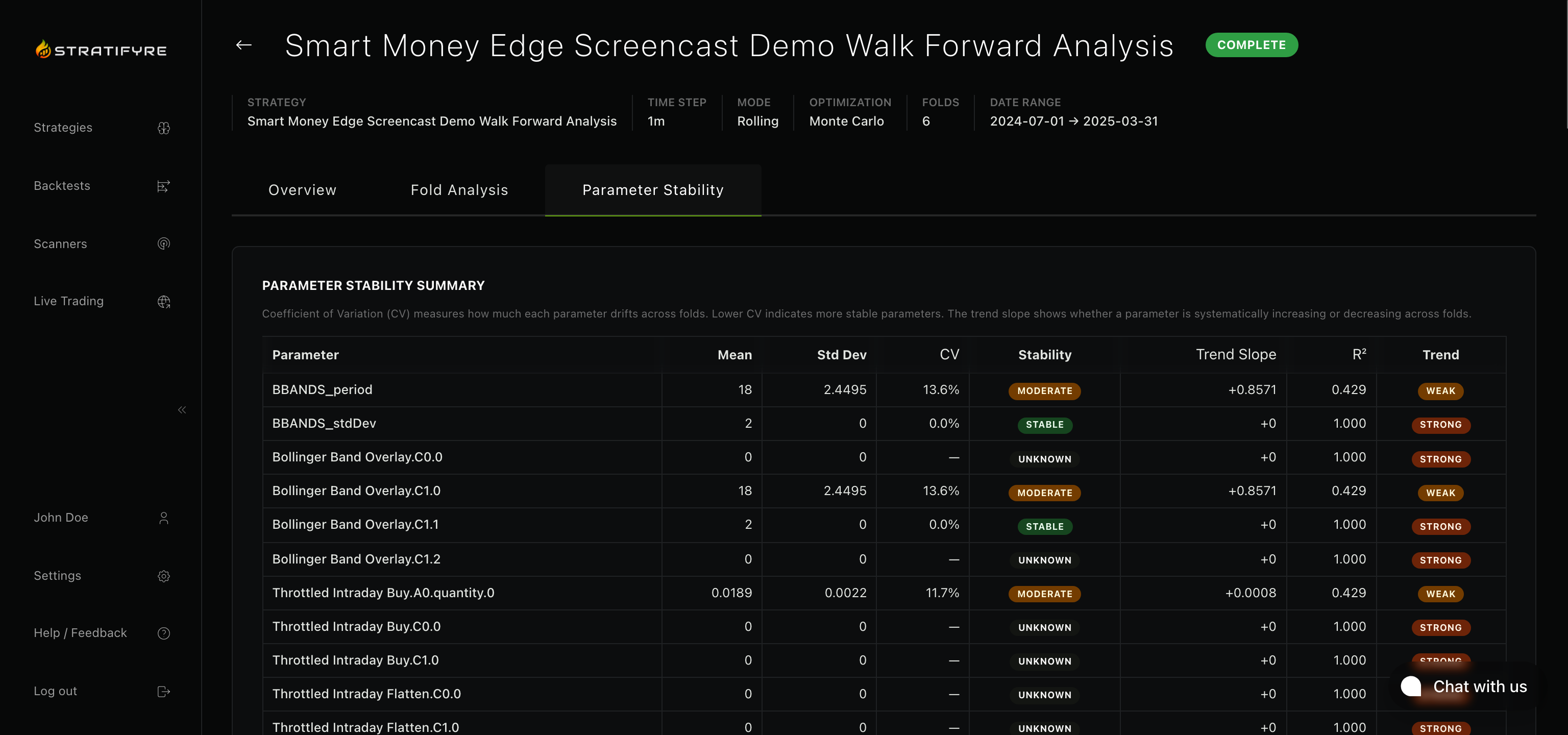
Every Walk Forward Analysis produces a three-tab results dashboard that takes you from summary verdict to per-fold forensics to parameter stability analysis.


A backtest tells you what happened. Walk Forward Analysis tells you whether it will happen again.
Single run on full date range
Sequential folds with unseen validation data
No overfitting detection
Walk Forward Efficiency exposes curve fitting
One parameter set, one result
Per-fold optimization with parameter stability tracking
Parameters chosen by user intuition
Monte Carlo or Grid Search optimization per fold
No measure of generalization
Consistency Ratio across 3–20+ OOS windows
Backtest = best case scenario
OOS results = realistic forward performance estimate
Static performance metrics
Real-time progress tracking during analysis
Walk Forward Analysis is the gold standard of strategy validation. If your edge survives on data it has never seen, you can trade it with confidence.