How corporate actions change a running backtest
Why splits, renames, membership removals, and mergers require coordinated changes to positions, orders, lots, quotes, and strategy memory.
An adjusted stock chart can make a split look smooth. The backtest still has to transform a portfolio that already owns shares, has pending orders, tracks acquisition lots, and remembers earlier strategy decisions.
That state is where corporate-action engineering becomes difficult. Each subsystem can produce a plausible answer independently while their combined result creates or destroys value. Our Stratifyre acceptance controls followed actual production Rust execution through splits, renames, and declared merger settlements, checking the state on both sides of each event.
A split changes units throughout the engine
In a simple four-for-one split, share quantity multiplies by four and corresponding per-share price levels divide by four. Aggregate acquisition basis stays constant. The transformation must reach every affected owner of those units.
One production control began with 10,000 seeded AAPL shares. After the split it held 40,000 shares, while the single lot’s $500,000 aggregate basis and the account’s $1,000,000 cash remained unchanged. Those are acceptance-fixture values, not a trading recommendation or a strategy performance result.
| State | Required relationship in the qualified split model |
|---|---|
| Position quantity | Multiplies by the split ratio |
| Aggregate lot basis | Remains conserved |
| Corresponding order price levels | Divide by the ratio |
| Pending order quantity | Multiplies by the ratio |
| Historical signal inputs | Remain comparable in their declared share frame |
| Strategy decisions | Preserve meaning rather than reset because units changed |
An order-level production control used a qualified AAPL/MSFT static basket. The same GTC order changed from 3 shares at $1 to 12 shares at $0.25, with no fills and no reset of its Once state. Those limit prices belong to the pending-order fixture; they are not historical market-price claims.
Preserving that order’s identity matters. Canceling it and silently creating a replacement can change priority, algorithm ownership, or the rule’s permission to fire again. A numerical adjustment alone does not prove preservation of those semantics.
A split changes units, not value
Before split
100 shares × $80
$8,000
Holding value
After 4:1 split
400 shares × $20
$8,000
Holding value
Adjust only the price: 100 × $20 = $2,000. A $6,000 accounting error.
Strategy memory has financial consequences
A running strategy holds more than a current indicator value. It may retain a moving-average window, condition history, a cooldown, or a record that a Once rule has already acted. Execution algorithms may also own partially filled parent and child orders.
Consider a labeled illustrative rule: enter once when price crosses a warmed moving average. If a split adjusts the latest price but leaves the historical window in old units, the rule sees a mechanical discontinuity. If the engine rebuilds the instrument from scratch, it can lose warmup or allow another entry that the rule should prohibit.
The implementation must identify which state contains price or quantity units, which state belongs to the continuing security, and which state represents an already completed decision. Each category needs its own transformation or preservation rule.
That work crosses the indicator pipeline, evaluator, broker simulation, lot ledger, and algorithm engine. Splits arriving beside renames or partially filled orders make ordering consequential. Tests must inspect pending state and later decisions as well as the final holding.
Our adjusted versus unadjusted stock-backtest article covers inconsistent chart and execution scales. The runtime has to carry the same consistency into every stateful consumer.
A rename must retain the continuing owner
A ticker rename should preserve the continuing listing’s position, orders, lots, and relevant strategy memory. Giving the new name a fresh owner can strand the old holding or cause the same rule to run again. Reusing an owner for an unrelated security with the same name causes the opposite error.
Production FB/META controls retained the same pending order, position, lot and basis, Once decision, and history through the rename. A separate targeted filled-order control retained its single one-share fill at $195.10. The pending and filled controls exercise different states; neither can substitute for the other.
Preserving a displayed ticker is only a small part of this operation. A runtime must reconnect historical data, active evaluation, quote routing, order ownership, and replay to the same continuing financial instrument. Rules referencing an instrument by name also need the correct dated binding.
Membership removal and financial retirement have different effects
Leaving an entry universe changes eligibility. It does not necessarily extinguish an existing position. A strategy can retain a holding with protective exits, or apply an explicit liquidation policy. Either choice needs continued access to the appropriate prices and consistent order handling.
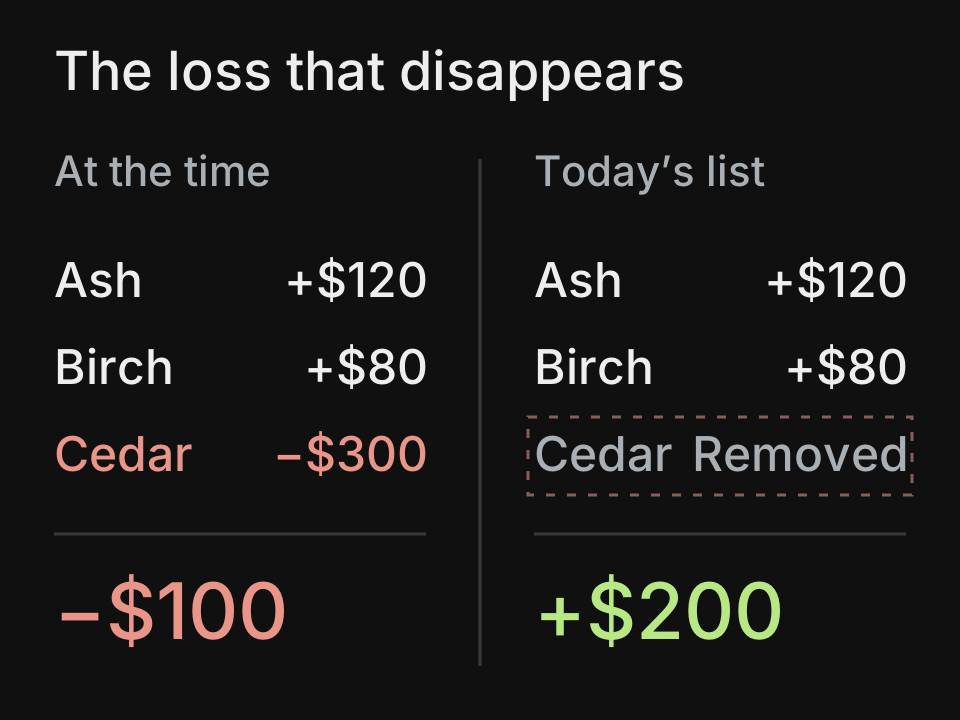
A security’s final trading quote and the end of its financial obligations can also differ. A position can stop trading while a declared settlement remains outstanding. Discarding it at the last bar loses the obligation; marking it indefinitely at its last quote can preserve value that should already have settled.
Corporate-action models therefore need more than an event name and a date. Entitlement, effect, and payment can be distinct transitions. The engine must know when the holder qualifies, when positions or claims change, and when cash or successor securities become available. When source data lacks a needed clock, a simulator convention must be explicit.
Provider feeds supply different parts of that contract. Sharadar’s action documentation includes splits, dividends, ticker changes, delistings, and acquisition counterparties. The adapter still has to qualify the fields required by the simulator. Sharadar corporate-action documentation.
Merger settlement introduces another instrument and another quote
A cash merger needs an explicit consideration amount and qualified timing. A stock merger needs a successor identity and delivery ratio. Mixed consideration introduces both, plus basis, tax-treatment, and fractional-unit decisions under the declared simulation model.
The production acceptance controls recorded these outcomes:
| Qualified control | Observed financial result |
|---|---|
| TWTR cash merger | Source position closed; final cash $1,542,000 |
| XLNX stock merger, GSPC and explicit controls | 17,234 AMD shares valued at $112.30; market value $1,935,378.20; equity $2,935,378.20 |
| AET mixed merger, explicit control | 8,378 CVS shares; cash $2,450,000; basis $675,183.02; equity $3,125,937.04 |
These figures describe seeded acceptance cases under their declared settlement models. The AET result is an explicit-instrument control; broader GSPC membership and identity gaps prevented treating that whole interval as qualified. They do not establish support for every merger structure or investor tax situation.
The XLNX control also exposed a runtime failure that share delivery alone would have missed: the successor’s valuation could retain a stale quote outside regular trading hours. Repairing it required correct successor ownership and quote processing, including the treatment of quotes arriving before the successor was held. Missing-owner errors remained strict.
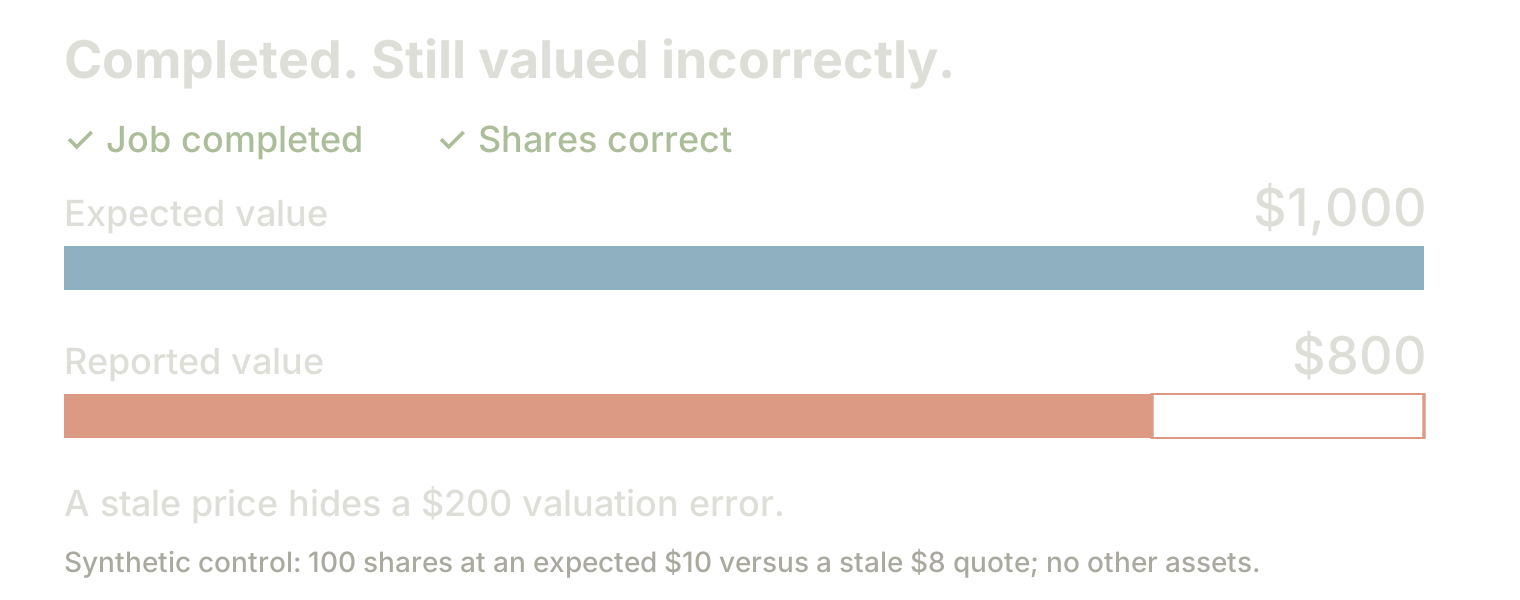
Shares can be correct while equity is wrong. That is why a merger oracle needs quantity, cash, basis, the applicable quote, market value, and account equity together.
Every event needs an auditable state transition
The hard work lies in identifying all affected state and applying a coherent transition. A split must not create cash. A continuing rename must not erase rule history. A settlement must not be applied twice after a retry. A removed member must not receive a fresh exposure-increasing entry through a delayed order.
Each event also needs a persisted explanation: which source revision supplied it, which model applied, what changed, and which execution attempt owns the receipt. A smooth equity curve cannot answer those questions on its own.
To audit a corporate action, start with a holding or pending order that actually crosses the boundary. Trace its quantity, basis, cash, orders, evaluator state, and quotes before and after the event. Then inspect the subsequent trading decision. Continue with how to verify a point-in-time backtest for the acceptance process that connects those assertions to a deployed run.
Put your strategy rules to the test
Build your strategy, inspect historical trades, and review the assumptions behind your results.
Build and test your strategy