S&P 500 backtests: historical members versus today's stocks
Avoid carrying today's S&P 500 stock list into the past: check membership dates, delisted data, and what your strategy could have known.
Before trusting an S&P 500 stock-strategy backtest, check which stocks were allowed to trade on each historical day. A list downloaded today answers a different question from the list that existed when those trades would have happened.
That difference can affect the stocks selected, trades taken, and losses included. Historical membership is the starting point; you also need usable prices for former members and clear rules for when additions and removals take effect.
What today’s list brings into the past
Suppose you select the stocks in an index at the end of a period, then apply your strategy to their earlier price histories. You have used the later membership decision to choose earlier trading opportunities. Future additions can enter your test before they entered the index, while former members disappear from the experiment.
This combines look-ahead selection with a survivorship problem when missing companies include delisted securities. Daniel, Sornette, and Wohrmann studied how end-period benchmark selection can overstate performance and understate risk. Their findings establish the problem, not a correction percentage for your strategy. Original benchmark-bias research.
A fixed list can still be useful. It asks, “How would this particular collection of stocks have behaved?” It cannot establish how a strategy restricted to historical S&P 500 members would have traded. QuantConnect’s research guide also identifies current index constituents used in historical testing as a source of look-ahead and survivorship bias. QuantConnect research guidance.
Tesla’s addition shows why the dates matter
On November 16, 2020, S&P Dow Jones Indices announced that Tesla would join the S&P 500 before trading opened on December 21. The company being replaced had not yet been named. November announcement.
The December 11 announcement identified Apartment Investment and Management, ticker AIV, as the S&P 500 removal, with the same December 21 effective boundary. It also described AIV’s spin-off of Apartment Income REIT; removal from an index is not itself evidence of a bankruptcy or exchange delisting. Addition and removal announcement.
| Date | Verified event | Consequence for a membership-only rule |
|---|---|---|
| November 16, 2020 | Tesla’s forthcoming addition announced | An announcement exists; Tesla is not yet a member |
| December 11, 2020 | AIV named as the stock being removed | The future replacement is known; it is not yet effective |
| Before the December 21, 2020 open | Tesla added; AIV removed | The eligible stock set changes for that session |
Carrying an end-of-2020 stock list back to January would allow Tesla into a “members only” test months before its addition. The same mistake can exclude AIV from dates when it was still a member. These are eligibility differences, not measured strategy returns.
The practical check is small: inspect each stock immediately before and after the effective session. Confirm the universe changes at the intended boundary before interpreting a longer equity curve.
Membership time and knowledge time are different
Membership time answers, “When was this stock actually in the index?” Knowledge time answers, “When could a trader have known this change was coming?”
A strategy that trades existing members uses the effective boundary. A strategy that trades announced additions needs the announcement’s availability time and a later executable trade time. Giving both strategies the same calendar date can grant information too early or make a stock eligible too soon.
The July 2026 S&P U.S. methodology specifies an announcement time of 5:15 p.m. Eastern for additions and deletions. That current convention does not establish an exact timestamp for every older announcement. Use the historical release for the event being tested, and do not infer a morning trading opportunity from a date-only field. S&P U.S. Indices methodology, Announcements.
For daily bars, write down whether a stored removal date means “last session included” or “first session excluded.” For intraday research, verify the effective time and exchange timezone. A field called “as of” is insufficient unless you know whether it describes membership, publication, or the provider’s data snapshot.
Freeze two universe definitions before comparing
Change only the stock-selection history in the comparison:
- Frozen members: save one constituent snapshot and its capture date; keep those stocks eligible throughout the test.
- Historical members: begin with the members eligible at the start, then apply additions and removals at their verified effective boundaries.
Loading every stock that appears somewhere in the historical window is not enough. That union supplies the data needed by the test; it does not make every stock eligible on every day.
Keep the strategy rules, signal interval, date window, initial cash, sizing, fees, slippage, sessions, and corporate-action treatment identical. Specify whether a completed-bar signal fills at a later bar’s open. Define indicator warmup for newly eligible stocks, and distinguish using earlier prices to prepare an indicator from allowing earlier entries.
Also freeze the handling of open positions when a stock leaves the universe. Does removal block new entries, require liquidation at the next executable price, or allow the existing exit rules to continue? These choices can change holding periods and costs independently of membership selection. Ensure your simulator implements the chosen policy before launching the comparison.
Audit coverage before trusting either curve
A historical membership table is not a complete historical trading dataset. Check these cases explicitly:
| Check | Evidence to inspect |
|---|---|
| Former members | Prices exist during their eligible dates, including the final relevant sessions |
| Delisted securities | Documented terminal treatment, rather than silently dropping the stock or position |
| Renamed or reused tickers | Instrument identity connects the correct company’s history |
| Repeated membership | Separate inclusion periods survive a removal and later re-entry |
| Unknown membership dates | Missing boundaries are flagged, with a documented handling policy |
| Missing prices or identifiers | Exclusions are listed and explained for both variants |
Retain an exclusion ledger with the symbol, affected dates, reason, and consequence. If a missing series prevents a fair comparison, narrow the question or repair the data; do not remove inconvenient stocks silently and call the remaining universe complete.
Review the differences in eligible names and resulting trades before headline performance. A return gap alone does not explain whether the cause was a later addition, an omitted former member, missing prices, or the removal policy. Report drawdown, turnover, exposure, and costs alongside returns after actual runs exist. There is no universal survivorship-bias percentage to subtract from an unverified backtest.
Trading members is a different experiment from trading SPY
An equal-sized portfolio of eligible stocks is not the S&P 500’s weighting rule. S&P’s methodology describes float-adjusted market-capitalization weighting; matching membership alone does not reproduce the index. S&P index methodology.
SPY is an ETF whose stated objective is to correspond generally to the index’s price and yield performance before expenses. A rule trading SPY uses that fund’s trading history and distribution treatment; it does not need to select individual constituent stocks. State Street’s SPY fund description.
Choose the test that matches your intended trade: a rule across historical member stocks, an index-replication portfolio, or a rule on the ETF. Label the benchmark’s price-return or total-return treatment so reinvested distributions do not become an unexplained advantage.
Check your basket before the long backtest
In the actual demo account, the saved S&P basket is named GSPC and returned 513 instruments when inspected on October 2, 2026. Its response supplies a snapshot and update time, without dated membership rows. The documentation’s EQ:GSPC identifier did not return the same saved basket. Neither response establishes historical eligibility for December 2020.

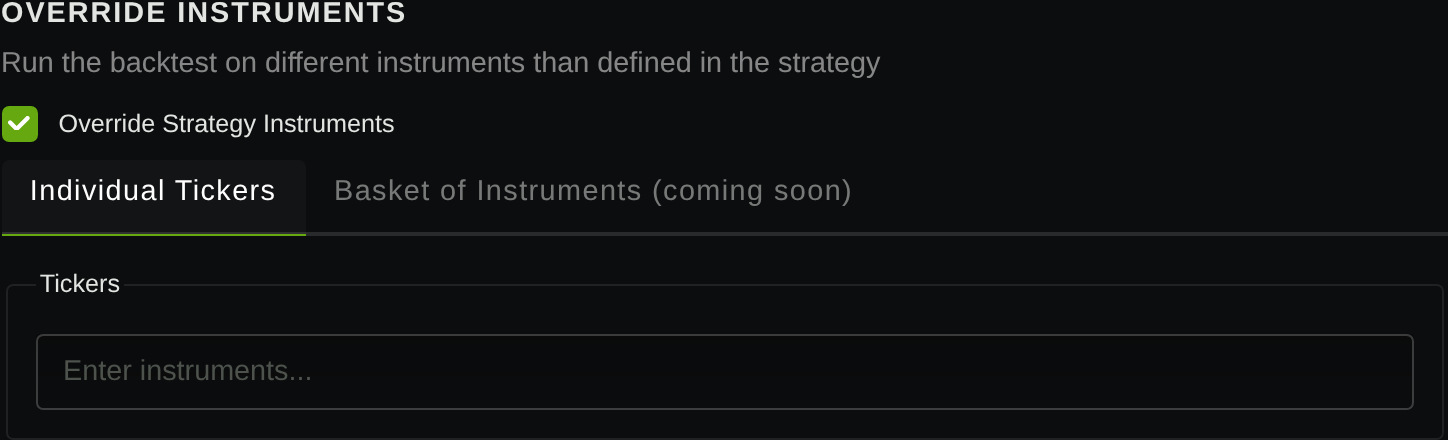
We attempted a daily basket run for December 17–23, 2020, spanning the Tesla/AIV boundary. It terminated with an engine error before producing usable trades or instrument results. A second attempt using the full frozen snapshot was rejected by this demo account’s 100-instrument limit, because the snapshot contained 513 names. No historical-versus-current return difference was measured.
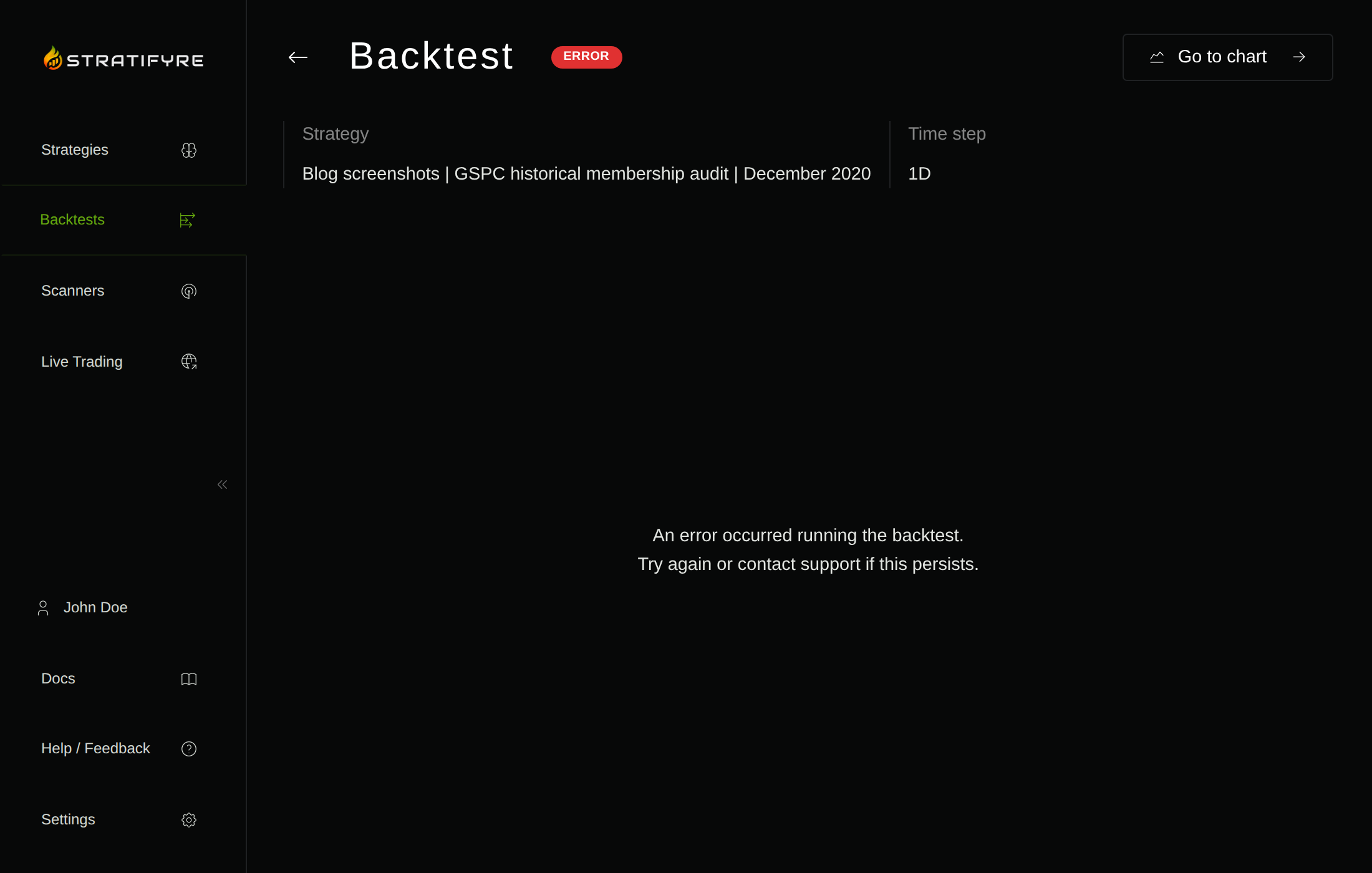
Start with one verified change, such as Tesla and AIV in December 2020. A successful boundary check supports that example; it does not prove all historical constituents or delisted prices are covered. Extend the audit to the rest of your period before treating a full comparison as evidence.
Inspect the basket and universe documentation before testing your historical stock universe.
Put your strategy rules to the test
Build your strategy, inspect historical trades, and review the assumptions behind your results.
Build and test your strategy